
How Jan Aushadhi and Generic Drug Policies Are Reshaping the PCD Business
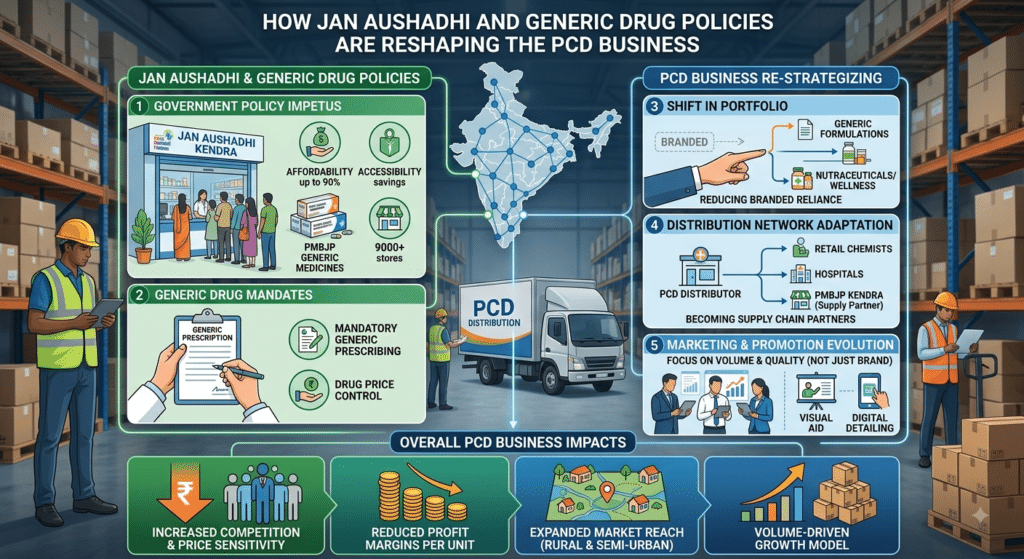
Indian pharma is witnessing several changes. Other than an improvement in health consciousness, various government schemes aimed at making medicines affordable also have a role to play in the production, distribution, prescribing, and selling of medicines. One of the latest trends that has developed in the area is the emergence of generic medicines under the Pradhan Mantri Bhartiya Janaushadhi Pariyojana (PMBJP).
This development is especially crucial for entrepreneurs since not only generic medicine, but also the conventional PCD pharma franchise business is being revolutionised. Customers have started preferring quality medicines at an affordable price, while pharma entrepreneurs are becoming choosier when it comes to portfolios of products, margins, manufacturing and company assistance.
As per the official website of PMBJP, there were over 19,000 Janaushadhi Kendras operational in India by March 2026 with a product basket of 2,100 medicines and 300 surgical items. The program claims that medicines under Jan Aushadhi are 50%-80% cheaper compared to the branded ones.
What then does all of this mean for the PCD pharma business?
Jan Aushadhi Scheme Meaning And Its Importance
The idea of the Jan Aushadi scheme came into being in 2008, initiated by the Department of Pharmaceuticals, whose main motive behind introducing this scheme was to provide affordable medicines. The working of this scheme takes place via Janaushadhi Kendras and is managed by the Pharmaceuticals & Medical Devices Bureau of India (PMBI).
The initiative focuses on spreading awareness among people about generics and makes medicines available at a lower cost that are approved by NABL laboratories.
This initiative makes sure that low costs do not indicate low quality, thus creating a price-sensitive market for the pharma industry.
Impact of Generic Policies on the PCD Pharma Industry
Importance of Pricing in Competitive Advantage
In the traditional system of PCD Pharma business, factors such as the quality of product, relationship with doctors, promotion, accessibility, and pricing determine business success. However, due to rising awareness about generics, pricing is becoming an even more important factor.
PCD franchisees have to check if the products have competitive pricing, without compromising the quality.
Companies have to keep the quality, pricing, differentiation, and business profit margin balanced.
Importance of Quality cannot be Neglected
An increase in generic medicines is drawing more attention towards the quality of manufacturing.
Medicines procured through this plan have been approved by WHO GMP and also undergo testing in NABL-accredited labs according to PMBJP.
This shows that if someone is selecting a pharmaceutical company for PCD business, he/she must consider the certifications, regulatory compliance, quality of product, and consistent supply.
PCD companies require an optimal product portfolio
Several therapy areas, including cardiology, diabetes, hypertension, gastroenterology, anti-infective products and nutrition support, are potential as per local market needs and product portfolio.
An optimal product portfolio will help the franchise owners to remove those excess products from their portfolio which do not have any market demand.
Entrepreneurs Are Diversifying Their Business Model
The success of Jan Aushadhi in making generic drugs available via a dedicated and organised network of outlets proves that the franchise scheme is a successful way of selling affordable generic medications.
Conversely, the PCD pharma business model continues to be lucrative for entrepreneurs interested in creating a business that will distribute pharmaceuticals without producing anything.
What this means for PCD Pharma Franchise Owners?
The changing landscape of generic drugs provides both opportunities and threats.
The PCD franchisee needs to be more observant about the following issues:
- Competitive pricing
- Consistency of product
- Availability of product
- Therapy areas that apply
- Qualifications of manufacturers
- Physicians and retailers’ engagement
- Promotion of products
- Sustainability of profits
The greatest area of opportunity is that people are becoming aware of the value for money in the form of affordable medicines in India.
The greatest threat is the increasing competition in the business. Entrepreneurship cannot be sustained based on prices alone.
Scott Morrison: A PCD Partner for a Dynamic Market
For such individuals looking forward to entering into or growing in the PCD pharma industry, Scott Morrison is a pharmaceutical company offering PCD franchises as well as multiple formulations.
Scott Morrison is a part of Hacks and Slacks Healthcare and focuses on providing formulations in the category of cardiac, diabetes, and hypertension drugs. We provide several formulations with ISO and DCGI certification. The PCD partnership is based on a monopoly system where the franchisees can establish their business in the market of their choice.
Such entrepreneurs who wish to invest in the chronic care segment will find this positioning relevant for them.
Scott Morrison works with selected pharmaceutical companies and professional practitioners who are certified, along with emphasising product quality as well as technological practices in accordance with industry norms.
PCD Companies’ Future in a ‘Generic First’ Environment
The growing popularity of Jan Aushadhi does not spell the end of the PCD pharmaceutical companies but forces them to adapt and focus on price and quality awareness as well as professionalisation.
While the government pushes patients towards using cheaper generic drugs, PCD companies respond by building competitive portfolios and business models.
If you are a new entrepreneur, you must consider more than just “What margin will I earn?” as the question to ask when selecting a PCD company.
Your questions should include,
How reliable are the products? Is the price competitive? Is the company compliant? Am I able to maintain a steady supply? Is the product line in line with my territory? What marketing assistance can I expect?
These questions may determine if your PCD franchise is going to be a sustainable business venture or yet another short-term investment.
Conclusion
Jan Aushadhi and India’s move towards generic drugs have altered the pharmaceuticals distribution scenario.
To PCD pharma business people, the lesson here is clear: success will favour those who can balance quality, cost, regulatory compliance, availability, and good franchise support in their business operations.
It would be wrong to see generic-drug policies as mere competition but rather as a direction that India’s pharmaceutical industry is taking; hence, PCD pharma business people should take this into account.
Frequently Asked Questions
What is Jan Aushadhi?
It is an initiative of the government that provides quality generic medicines at affordable prices through specialised Kendras.
Is Jan Aushadhi effective?
Yes. Generic medicines that are approved by the government are equally therapeutic in effect as compared to branded ones.
How does Jan Aushadhi impact the PCD pharma?
There would be increased competition due to this scheme.
What is a PCD pharma Franchise?
It is a franchise of a pharma company that allows them to operate in a particular geographic area.
How do generics help PCD business?
It helps them to cope with the rising demand for low-cost medicines.
What should I keep in mind while choosing a PCD company?
One should ensure that the pharma company has quality products and certifications along with affordable pricing and supply chain services.
Does Scott Morrison provide any PCD franchises?
Yes. Scott Morrison provides PCD franchise opportunities in some of the therapeutic segments.