
Role of Quality Certifications in the Pharmaceutical Industry
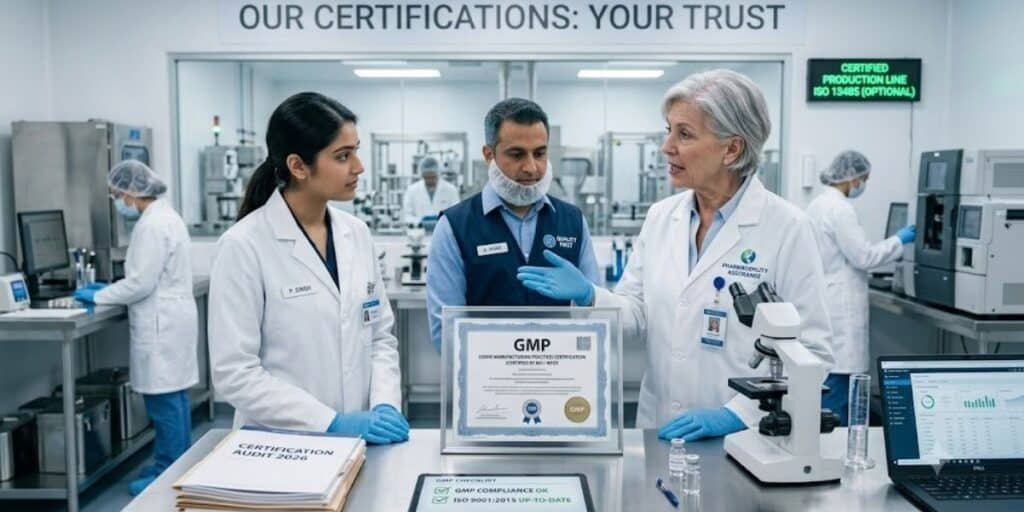
The pharmaceutical industry plays a significant role in maintaining public health at a global level. Ranging from manufacturing life saving drugs to producing over the counter medications, pharmaceutical companies have a direct impact on public health. In this regard, it becomes essential to ensure quality, safety, and efficacy in pharmaceutical products. This is where quality certifications play a major role. Quality certifications can be seen as standardized recognition of the quality of the products, processes, and operations of the companies, which adhere to the standards that have been set within the particular industry. The quality certifications can be seen as crucial elements towards ensuring that the medicines that are being developed by the companies within the particular country are safe, effective, and reliable, while at the same time helping the companies adhere to the strict regulations that guide the particular industry within the particular country and the world at large.
The quality certifications not only make the companies credible within the particular medical field, but they also provide the companies with access to the global market.
Understanding Quality Certifications
Quality certifications refer to approvals given to a company that indicate it meets set standards for:
- Manufacturing
- Distribution
- Quality management
In the pharmaceutical industry, quality certifications ensure that medicines are made under strict conditions.
These pharmaceutical quality certifications have various uses:
- Safety: Patients are protected from harmful or ineffective products.
- Regulatory: Companies can comply with laws.
- Credibility: Companies can gain trust in the market from healthcare providers, pharmacies, and consumers.
- Excellence: Companies can implement standardized processes and proper documentation.
Some of the most recognized pharmaceutical quality certifications include:
- ISO 9001: It is the international standard for quality management systems.
- WHO-GMP: It is the World Health Organization’s Good Manufacturing Practices.
- FDA approvals: These approvals are required for the manufacturing as well as selling of products in the US.
- CE marking: It is required for medical devices that meet the European safety standards.
Why Quality Certifications Exist?
Pharmaceuticals are contrary to most other consumer products: a defect is not just a quality compliant, it can also be a matter of life and death. The concept of quality control in pharma conventionally implied checking whether a finished product is in coordination with the pharmacopoeia standards. But running tests on the final products was not just the solution as contamination or cross mixing could happen anywhere in the manufacturing chain without showing up in a simple end product test.
This gap is what gave rise to Good Manufacturing Practice (GMP) in the 1960s in the United States and it is the World Health Organization that further played the major role in globalizing quality awareness via its Certification Scheme on the Quality of Pharmaceutical Products. This was established in 1969 to support countries in making sure the safety of medicines moving across international borders. At present quality certifications exist to get hold of and avoid problems throughout the entire lifecycle of a drug from raw material sourcing to storage and shipment instead of relying on inspection after the fact.
Also read: Why Pharma is Considered A Recession Proof Business Opportunity
Importance of Quality Certifications in Pharma
Patient Safety
First and foremost, quality certifications guarantee the safety of medicines in the country. The quality of the manufacturing environment, cleanliness, machines, and the level of training of the staff is also ensured, thus providing a guarantee of the safety of the medicines. Safe medicines translate to improved patient outcomes as well as the confidence of the people in the health care system in the country.
Regulatory Compliance
Pharmaceuticals are a highly regulated industry. In this, any form of non-compliance may lead to:
- Legal actions
- Recalls
- Restricted market access
The certifications create a guide for companies to abide by the regulations, hence enabling them to offer safe products to both local and international markets.
Market Access and Trust
Certifications create trust and quality, which helps enabling trust among:
- Hospitals
- Pharmacies
- Consumers
When it comes to international markets, a company may be required to acquire WHO-GMP or FDA approvals before allowing their exports to be imported. If a company does not acquire these certifications, it may not be able to access international markets for its products.
Operational Excellence
Quality certifications help instill operational excellence by promoting streamlined processes, documentation, and monitoring. This helps reduce errors, increases operational efficiency, and instills a culture of continuous improvement. Organizations that adopt quality certifications reap long-term operational benefits.
Certification Process: What It Typically Involves
While specific requirements vary by certifying body and standard, most pharmaceutical quality certifications follow a broadly similar audit lifecycle.
- Gap assessment: an internal or third-party review comparing current practices against the target standard’s requirements.
- Documentation and SOP development: written procedures covering manufacturing, cleaning, calibration, training, and deviation handling.
- Stage 1 audit: a readiness review of documentation and system design.
- Stage 2 audit: an on-site assessment of actual practices against documented procedures.
- Certification issuance: typically valid for a defined period, often three years, subject to conditions.
- Surveillance audits: periodic follow-up audits (commonly annual) to confirm ongoing compliance rather than a one-time check.
This cyclical structure is deliberate: certification is treated as an ongoing state of compliance rather than a badge earned once and forgotten, which is why surveillance audits and periodic recertification are built into nearly every major framework.
Key Pharmaceutical Certifications and Standards
WHO GMP (Good Manufacturing Practices)
WHO GMP emphasizes safe and consistent manufacturing practices. This is because WHO GMP standards minimize product defects and contamination . These ensures that facilities are:
- Clean and hygienic
- Proper documentation is maintained
- Proper training is given to employees in all stages of production
ISO 9001
ISO 9001 is a worldwide quality management standard that focuses on:
- Customer satisfaction
- Process improvement
- Delivery of quality products
It is a standard that many pharmaceutical companies implement to enhance operational efficiency and competitiveness.
FDA Approvals
The Food and Drug Administration, a body of the United States government, is responsible for testing and approving medicines and manufacturing processes in the country and abroad.
Other Standards
ISO 13485 – For medical device quality management.
CDSCO (India), EMA (Europe) – Certifications for national regulatory bodies for market approvals.
CE marking – For medical devices and medicinal products that comply with European standards.
Also Read: How to Evaluate Quality Before Choosing a Franchise
Benefits to Pharmaceutical Companies with Quality Certifications
- Credibility and Trust: It increases trust with doctors, distributors, and patients.
- Operational Efficiency: It minimizes errors, wastes, and manufacturing delays.
- Market Expansion: It allows access to international regulated markets.
- Legal Protection: It minimizes risks of fines or product recalls.
- Constant growth: It encourages continuous monitoring and upgrade in procedures and training.
Challenges in Achieving and Maintaining Certifications
Although the advantages of quality certifications are significant, the following challenges may be faced while implementing quality certifications:
- Implementation Costs: The implementation of infrastructure following GMP may be expensive.
- Staff Training: Employees may be required to undergo training on a regular basis.
- Regular Inspections: Regular inspections by government agencies may be challenging.
- Documentation: Companies may be required to keep detailed records of their activities.
- Staying Up to Date: The regulations may be constantly changing, which makes it necessary for companies to keep adapting.
Role of Quality Certifications in Pharma Export
Quality certifications may be necessary for exporting pharmaceutical products. For example, countries with stringent regulations like the US, Europe, and Japan require quality certifications like FDA approval, WHO-GMP, and ISO certification.
The certified companies benefit from:
- Market access to regulated regions
- Competitive edge over other manufacturers who have not been certified
- Building trust with international distributors and healthcare professionals
In the absence of these certifications, even high quality products will not be allowed to penetrate lucrative global markets, thus the need for these certifications in the success of businesses.
Future Trends and Importance
The pharmaceutical industry is witnessing tremendous changes:
- Regulatory pressures are on the rise globally.
- Digital technologies such as blockchain technology and auditors’ tools are aiding the tracking of product quality.
- Sustainable or ethical production is becoming more important.
Conclusion
In the pharmaceutical industry, quality certifications are vital as they guarantee the safety, efficacy, and compliance of the products. These certifications enhance the companies:
- Credibility
- Efficiency
- Entry into the global market
Pharmaceutical companies that value quality certifications earn the confidence of medical practitioners, thus enabling them to attain long-term business success.
FAQs about Role of Quality Certifications in the Pharmaceutical Industry
What are quality certifications in the pharmaceutical industry?
Quality certifications are the approvals that a company has achieved to prove that the processes, products, and services of the organization conform to the set quality and safety standards.
Why are quality certifications significant to the pharma industry?
Quality certifications in the pharma industry are significant as they not only prove the quality of the products, but also ensure the safety of the patients, the companies’ compliance with the government regulations, the companies’ credibility in the market, the efficiency of the companies’ operations, and the companies’ chances of exporting products to other countries.
How do quality certifications impact the exports of the industry?
WHO-GMP and FDA approvals are mandatory for the industry to export products to other countries such as the US, Europe, Japan, etc.
Are quality certifications hard to attain?
Yes, they require investment, training of employees, and regular audits, in addition to documentation. However, the advantages of these certifications far outweigh the disadvantages.
Can companies that are not certified compete in the pharmaceutical industry?
Yes, they can compete locally, but they will not have a competitive edge like certified companies.
What is the difference between GMP and WHO-GMP?
GMP is the general concept of good manufacturing practice, implemented and enforced differently across countries. WHO-GMP specifically refers to the World Health Organization’s own version of these guidelines, which is widely used as an internationally recognized benchmark, particularly for companies exporting to countries that rely on WHO prequalification.
Is ISO 9001 mandatory for pharmaceutical companies?
No, ISO 9001 is not mandatory in most jurisdictions, but it is widely adopted voluntarily because it strengthens the overall quality management framework and complements mandatory sector-specific standards like GMP.
How long does it take to get GMP certified?
Timelines vary based on the current state of a facility’s infrastructure and documentation, but the process, from gap assessment through stage 2 audit and certificate issuance, commonly takes several months to over a year for facilities that need significant upgrades.
Do certifications expire?
Yes. Most certifications are issued for a defined cycle, commonly three years, and require ongoing annual surveillance audits to remain valid rather than being a one-time achievement.
What happens if a company fails a compliance audit?
Depending on the severity of findings, a company may need to submit a corrective and preventive action (CAPA) plan within a set timeframe. Serious or unresolved violations can lead to suspension or withdrawal of certification, which can halt manufacturing, sales, or exports.